Sergels torg
Sergels torg is a major public square in the Norrmalm district of central Stockholm, Sweden. It takes its name from the 18th-century Swedish sculptor Johan Tobias Sergel, whose workshop was located nearby. The square was designed in 1957 and inaugurated in 1967 as part of the large-scale mid-20th-century urban renewal programme known as Norrmalmsregleringen, which dramatically reshaped Stockholm's city centre.
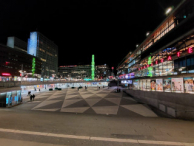
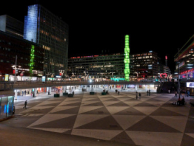
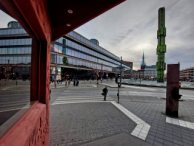
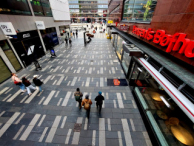
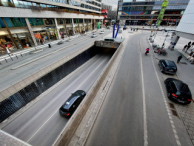
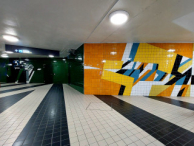
The square is divided into two main levels: an upper level dominated by a superellipse-shaped traffic roundabout, and a sunken pedestrian plaza known colloquially as Plattan ("The Slab"), notable for its striking black-and-white triangular floor pattern. The centrepiece of the upper level is Kristall – vertikal accent i glas och stål, a 37-metre illuminated glass obelisk completed in 1974 by sculptor Edvin Öhrström.
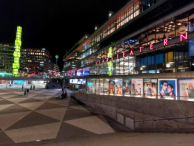
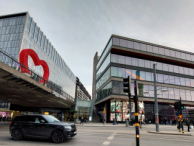
The southern edge of the square is defined by Kulturhuset, a glazed cultural centre designed by architect Peter Celsing and completed in 1974, which houses the Stockholm City Theatre. To the north stand the five Hötorget skyscrapers, built between 1955 and 1966. Sergels torg serves as a key transit hub and a traditional gathering point for public celebrations and political demonstrations.
| 









 Album:
