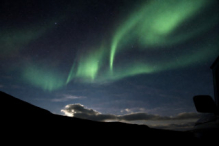
Northern lights over Iceland
The Northern Lights, scientifically known as the aurora borealis, are a natural light display predominantly seen in high-latitude regions around the Arctic. They are caused by interactions between charged particles from the Sun and gases in the Earth's upper atmosphere. When solar wind particles collide with atoms of oxygen and nitrogen in the thermosphere, they release energy in the form of light, producing vivid displays that shimmer across the night sky.
The phenomenon is most commonly observed in regions near the magnetic poles, including parts of Norway, Sweden, Finland, Iceland, Canada, and the U.S. state of Alaska. Auroras appear in various forms, including arcs, bands, curtains, and rays, and can display colors such as green, red, purple, and blue. Green is the most frequent color, produced by oxygen molecules approximately 100–300 kilometers above the Earth’s surface.
Auroral activity is influenced by the solar cycle, which lasts about 11 years and affects the intensity and frequency of displays. The Southern Hemisphere counterpart to the aurora borealis is the aurora australis, or Southern Lights. Throughout history, the Northern Lights have inspired myths and scientific study, becoming both a cultural symbol and an important subject in space weather research.
| 














 Album:
